
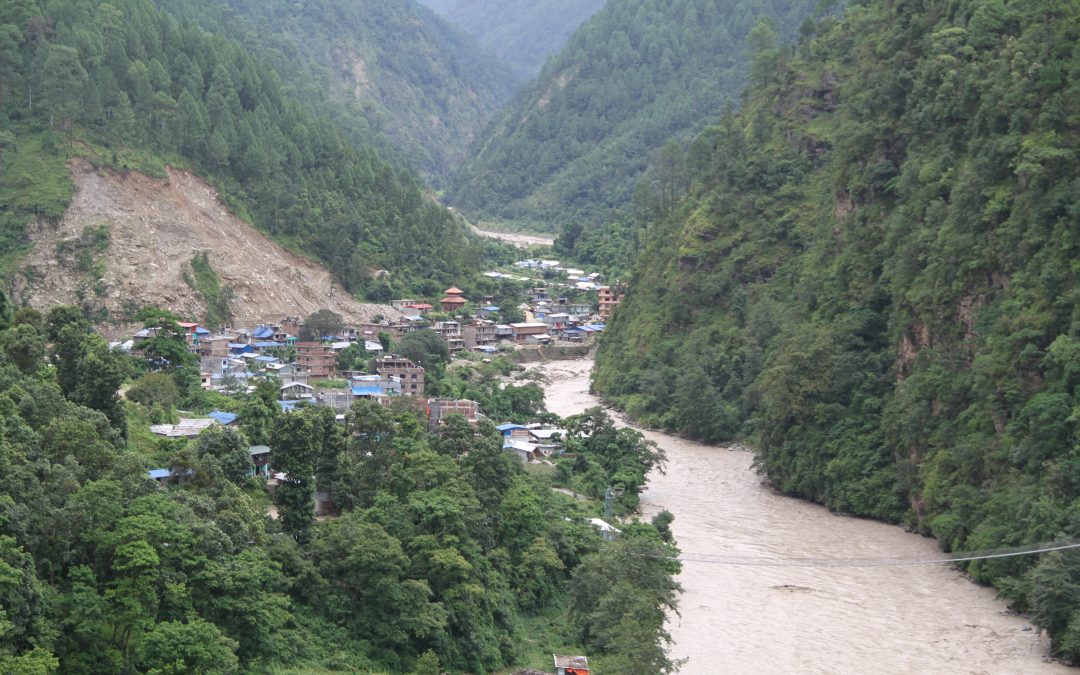
The education I received at St. Xavier’s through the support of the fund has instilled in me the values to do something good for my society. Given the range of issues that exist in our societies today, I find it imperative for youngsters to pick a battle and fight it. The battle I have chosen is climate change. Coupled with my university education, I have received excellent mentorship from my family, professors and mentors. Accordingly, I decided to spend this summer in the Himalayas studying the human impacts of climate change. As I like to say, ‘The Mountains are Melting’.
According to studies, Nepal’s temperature increases 0.04-0.06 degree Celsius annually. With the increasing temperature, glaciers are melting and forming glacial lakes, with water occasionally rising to threatening levels. According to a study by the International Center for Integrated Mountain Development (ICIMOD), there were 1,466 glacial lakes in Nepal in 2009. Among these, 21 are said to pose potential risks and six are considered to be at a high risk of an outburst. A Glacier Lake Outburst Flood (GLOF) resulting from the six lakes might affect hundreds and thousands of people in the human settlements below the lakes. In particular risk is the Tsho Rolpa Glacier Lake.


Despite these serious risks, it seems like the government has failed to implement effective mitigation measures to address the issue. Local residents have often shown discontentment and have made bottom-up decisions in adapting to and mitigating a Glacier Lake Outburst Flood (GLOF). However, such measures are rudimentary and cannot suffice the scale of the disaster. There are also numerous news articles that mention that local residents are unaware of the research findings in the glacial lakes conducted by the government and that they are left out in the policy process. However, there is very little literature on this topic and many people are not aware of the damage that can be caused by a glacier lake outburst flood. It is thus important to understand what is happening on the ground and to hear the voices of the local people. With this research, I am hoping to increase awareness on the importance of mitigating Glacier Lakes Outburst Flood (GLOF) throughout Nepal, alongside hearing the stories of local people.

 My experience over the past 1.5 months has been nothing less but inspiring. Speaking to countless of people who live in the frontlines of climate change has taught me the urgency of taking global action in combating what is perhaps the biggest threat to mankind. At the same time, I have also understood the complexity of adding up burdens of a changing climate to under resource families who struggle to provide basic necessities to their family. Mobilizing huge financial resources to combat climate change is a tricky concept in the Himalayas where families are struggling to rebuild their homes after the devastating earthquake. I spoke to some people who believed the money that was being used to create outlets from the glacial lakes could have been better utilized if they would have been provided money to rebuild their homes or promote tourism in the region. As my main site of study is not a tourist destination in the region dominated by the mighty Everest, local people have resentment against the government for not promoting tourism in the region. For instance, during my ten day walk I did not meet a single tourist in the region. The government had lowered the level of the glacier lake by building an artificial outlet due to scare of glacial flooding. However, many local people seemed upset because the lake does not look as pretty anymore; something they believe has caused the number of tourists in the region to decline.

Glacial Flooding is an imminent threat to the downstream communities. Yet, dealing with climate change seems to be a secondary issue compared to other necessities such as education and development. Nonetheless, the government alongside several environmental agencies have lowered the level of the lake decreasing the likelihood of glacial flooding. While the reaction of local people towards government intervention remains negative, the importance of mitigating a potential glacial flooding in Tsho Rolpa remains uncontested.


